
How Will Florida's 2026 Homestead Tax Amendment Affect Pinellas County Homeowners?
Pinellas County Taxes: The Simple Story
This page uses only real numbers from the government. It explains, in easy words, how much our county property taxes have gone up.
Florida's homestead exemption is headed to the November 2026 ballot, and if it passes, it could change property taxes for Pinellas County homeowners in a big way. Before you vote, here's what's actually on the ballot — explained in plain English, with real numbers pulled straight from public county and state records. No spin, and no telling you how to vote. Just the facts, so you can decide for yourself.
First, what is a property tax?
You live in Pinellas County, in Florida. The county helps pay for things that everyone uses — like police, firefighters, parks, libraries, and roads.
To pay for all that, the county collects money called taxes. If you own a home or land, you pay a property tax every year.
What are people voting on?
In November 2026, people in Florida get to vote on a new rule about property taxes. It is for the whole state, not just our county. It has three main parts:
Part 1 — A bigger tax break for your own home
Right now, you skip tax on the first $50,000 of your home's worth. The new rule would grow that to $150,000 in 2027, then $250,000 in 2028. So you would skip tax on more of your home and pay less.
But there is a catch: this bigger break does not count for school taxes. Your school taxes would stay the same.
Part 2 — A slower cap for stores, rentals, and other property
This part is about property that is not your main home — like stores, offices, apartment buildings, and vacation homes. These are called non-homestead property.
There is a rule that the taxable value of these can only go up so much each year, even if the real value jumps higher. Today that cap is 10% a year. The new rule would lower it to only 5% a year. That means their taxable value would grow more slowly — so these owners would pay less than they would have.
Part 3 — A wait for new movers
People who move to Florida after January 1, 2027 would have to live here for 5 years before they can get the bigger home break.
The rule needs 60 out of every 100 votes (60%) to pass.
The big number
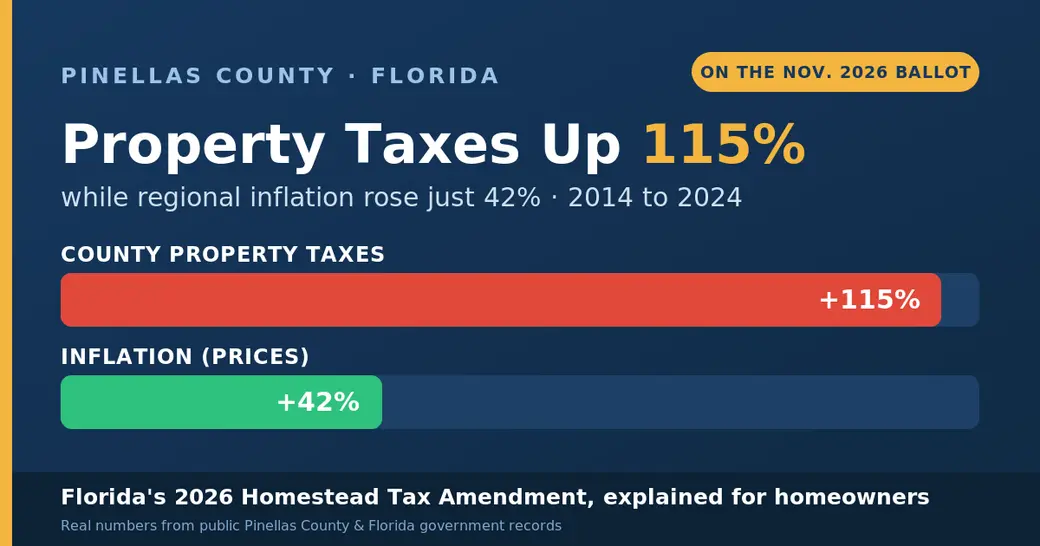
In Pinellas County, the money collected from property taxes went up a lot. Since about 2014 — around 10 years — it more than doubled.
But prices did not go up that fast
It is true that things cost more over time. This is called inflation. Since 2014, regular prices in our area went up about 42%. But county taxes went up about 115%.
Did paychecks keep up?
The middle family in Pinellas earned about $45,000 a year in 2014. By 2024 they earned about $73,600 — a nice raise, about 63% more. That even beat inflation! But county taxes went up about 115%, so taxes still grew faster than what families earn.
Did the county raise the tax rate?
No. The county did not raise the tax rate — they actually made it a tiny bit lower. So why did taxes go up so much? Because homes are worth more money now. When your home is worth more, you pay more tax even when the rate stays the same or goes down.
Who gets your property tax money?
Your property tax does not all go to one place. It gets split up. The biggest piece goes to schools. For every $1 of property tax in the county, here is about where it goes:
Schools collected about $955 million in property tax in 2025 — even more than the county's own main fund.
Property tax is only part of what schools get. Pinellas County Schools spends about $1.6 billion a year in all. Most of the rest comes from the state and the federal government.
Who else pays property tax?
It is not just the home you live in. Stores, offices, apartment buildings, and vacation homes pay property tax too. These are called non-homestead property.
How the vote changes this: remember Part 2 above? It would slow how fast the taxed value of these properties can climb each year — from a 10% cap down to a 5% cap. So these owners would pay less than they would have.
The numbers in one place
| What we measured | Start | Latest | Change |
|---|---|---|---|
| County property taxes | $296M (2014) | $637M (2025) | +115% |
| All property taxes (with schools) | $1.48B (2020) | $2.10B (2025) | +42% |
| School property taxes | $639M (2020) | $955M (2025) | +49% |
| Prices (inflation) | 2014 | 2024 | +42% |
| Family pay (income) | $45,162 (2014) | $73,605 (2024) | +63% |
| Homes worth (taxable) | $91.7B (2020) | $140.3B (2025) | +53% |
| Homestead homes | 249,105 (2020) | 254,873 (2025) | +2.3% |
| County workers | 5,418 (2020) | 5,564 (2024) | +2.7% |
| Store/office property | $14.2B (2020) | $19.3B (2025) | +35% |
What does it all mean?
These are just the real numbers. They show taxes grew much faster than prices and pay — even though the county lowered the tax rate a little.
People can use these facts to ask good questions, like: Are we getting more for the extra money?
This page does not tell you how to vote. It just shares the numbers so you can decide for yourself.
Where these numbers come from
Every number on this page comes from the government. Here is the list, so anyone can check it.
- The November 2026 vote — Ballotpedia and the Florida Senate news release
- How much tax the county collected — Florida Dept. of Revenue, Comparison of Levies (Pinellas, 2014 and 2024)
- Who is taxed, incl. schools — Pinellas Property Appraiser DR-403CC (2025, 2020)
- Home values, homesteads & commercial — Pinellas Property Appraiser Tax Roll Annual Reports (Tax Roll Summary, DR-403EB, Land Use Recaps, 2020/2024/2025)
- Prices (inflation) — FRED / U.S. Bureau of Labor Statistics, Tampa–St. Petersburg CPI
- Family pay (income) — FRED / U.S. Census, Median Household Income, Pinellas County
- County spending & workers — Pinellas County financial reports (2024 ACFR) and adopted budget books
- Schools — Pinellas County Schools 2024-25 Approved Budget
- Safety & quality of life — PCSO statistics, Crime Viewer, FDLE crime reports
This page is for learning only. The numbers come from the public government reports listed above. Some numbers use the “fiscal year,” which is the government’s money year. County tax amounts are the Board of County Commissioners and all county taxing groups added together.
Categories
- All Blogs (88)
- Beach Life (5)
- CDD Fees (1)
- Clearwater (2)
- Coastal Living (2)
- Education & Schools (1)
- Family Life in Tampa (2)
- Financial Planning (11)
- Investing in Tampa Bay (4)
- Land O' Lakes (1)
- Largo Florida (1)
- Lifestyle & Culture (23)
- Living in Tampa (10)
- Luxury Living (2)
- Market Insights (20)
- Moving to Tampa (18)
- Neighborhood Guides (13)
- Neighborhood Spotlight (10)
- Odessa (1)
- Palm Harbor (1)
- Parrish (2)
- Pros & Cons (1)
- Relocation Guide (17)
- Relocation Tips (52)
- Remote Work (1)
- Sarasota (1)
- Seminole (1)
- St. Petersburg (5)
- Tampa Cost of Living (3)
- Tampa Developments (3)
- Tampa Lifestyle (9)
- Tampa Neighborhoods (4)
- Tampa Suburbs (3)
- Things To Do in Tampa (1)
- Two Rivers (1)
- Walkable Neighborhoods (3)
- Wesley Chapel (2)
- Zephyrhills (1)
Recent Posts